
MacLennan, K., Woolley, C., @ 21andsensory, E., Heasman, B., Starns, J., George, B., & Manning, C. (2022). “It is a big spider web of things: sensory experiences of autistic adults in public spaces”, Autism in Adulthood.
What did this study aim to do?
This study aimed to understand:
- Which public places autistic adults find to be the most disabling and most enabling, due to the sensory environment
- What sensory-related factors make these public places more or less disabling
What did we do?
We hosted online focus groups with 24 autistic people (age 18 – 24 years) to talk to them about their experiences of public places. Throughout this study, we also consulted with autistic people to get feedback on what we were doing and how we were interpreting the results.
What did we find?
First, we identified the most common disabling (disliked) and enabling (liked) public places for autistic adults.
The most disabling sensory environments are:
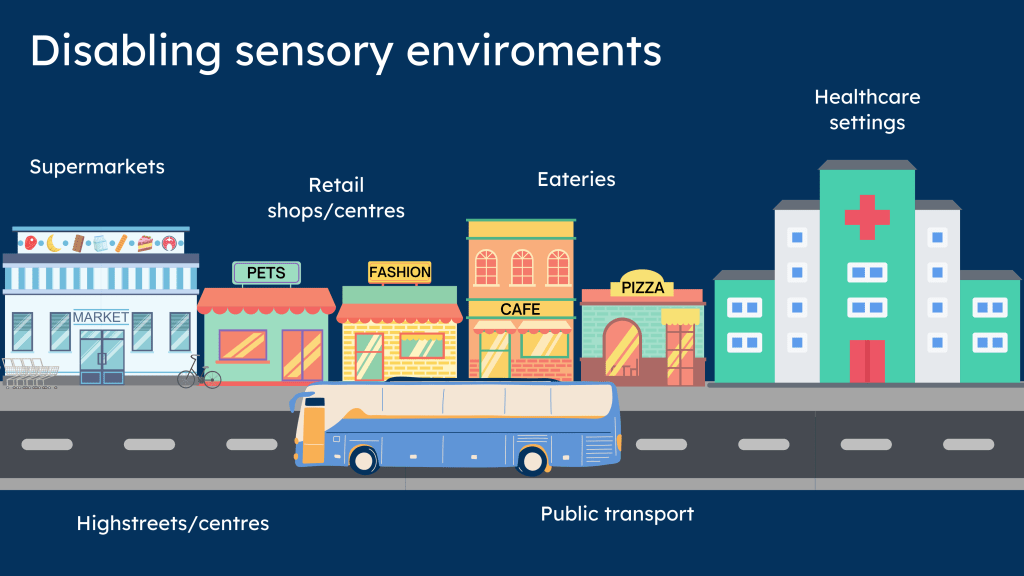
The most enabling sensory environments are:

We then identified 6 principles that related to whether public places were disabling or enabling sensory environments. Emily @21andsensory designed a sensory web of the principles (image below). The outer edge of the web represents the more disabling end of the scale, whereas closer to the centre of the web represents the more enabling side.
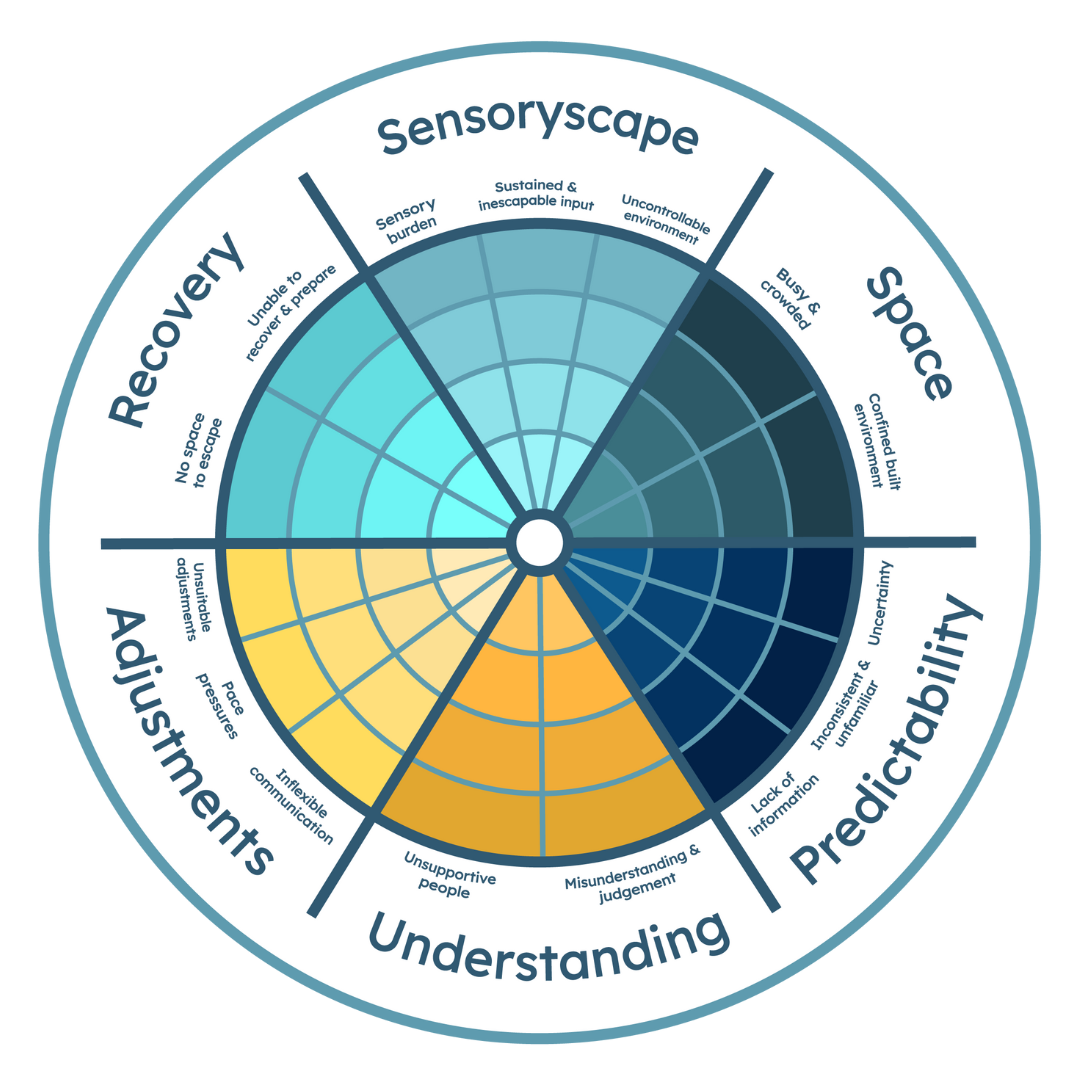
“I always envisage it is a big spider web of things that might affect me in a sensory environment, and I want to say to people, it’s about actually looking at all those little things that build up…”
Autistic research participant
Sensoryscape (sensory landscape)

Sensoryscape relates to the sensory inputs in a public place, such as the different sounds or smells. Places that are disabling have:
- A high sensory burden (intense or lots of layers of sensory input)
- Sensory input that is sustained (it does not stop) and inescapable (you can’t get away)
- Sensory input that cannot be controlled (you can’t stop it)

Space relates to how closed in or open spaces feel for people. Places that are disabling have:
- Busy and crowded spaces, with lots of people making extra sensory challenges, such as noise and being bumped into
- A confined built environment, with buildings that have narrow and closed in spaces, such as small rooms, corridors, and aisles

Predictability relates to how much is known about a public place and what can be expected. Places that are disabling have:
- A lot of uncertainty around what to expect
- Layouts that change often and spaces that are unfamiliar
- Not much information about how the place looks or how to do things, such as there not being maps or clear signage

Understanding relates to how much staff and the public know about autism and sensory differences. Places that are disabling have:
- Staff that cannot provide support as they do not have knowledge or training on autism
- Staff and public who misunderstand and judge autistic people who may be showing signs they are struggling
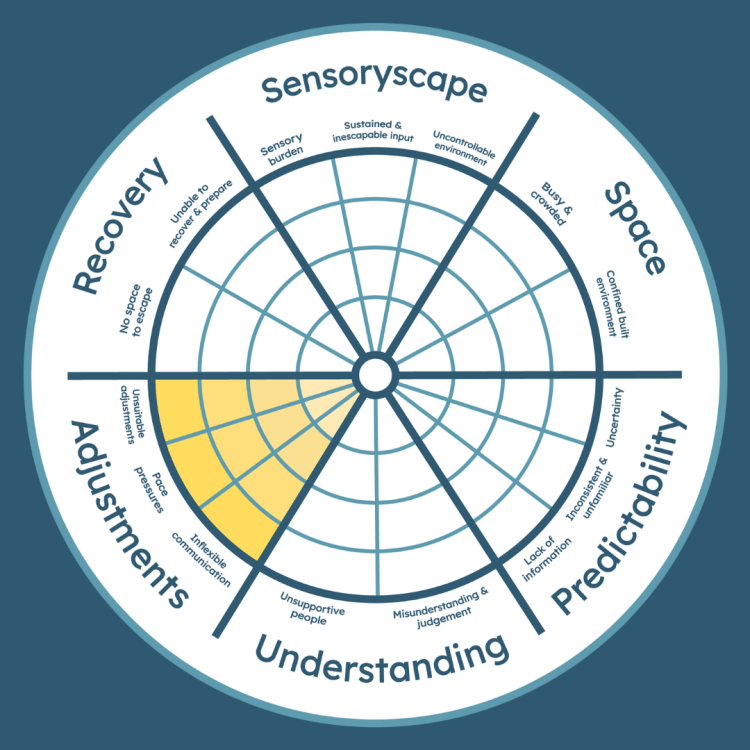
Adjustments relates to things that can be done or changes to support autistic people. Places that are disabling have:
- Pace pressures that do not allow people to take more time if they need it
- Inflexible communication, that may not work for people who struggle with speaking to others
- Unsuitable adjustments, such as having quiet hours at times when autistic people cannot go or not providing the right help under the Sunflower Lanyard Scheme

Recovery relates to the chance for people to escape sensory input and recover in public places. Places that are disabling have:
- No space, such as a room or seating in a quieter area, for people to escape from sensory input
- No chance for people to recover and prepare to re-enter the public place, which means they often have to leave and may not return.
What can you do?
Based on these findings, we have created some tips for managers and business owners so you can make your places more enabling for autistic people:
| Principle | Tips for managers and business owners |
| Sensoryscape | Remove unnecessary sensory input (e.g., background music) Have more regular quiet hours or reduce sensory input at all times Allow people to turn off/down lights or sounds |
| Space | Create a one-way systems Communicate your quieter times Consider designing more open spaces |
| Predictability | Provide maps of the layout that includes challenging sensory input Have clear signs that explain where things are and how things work Have information online so people can prepare in advance |
| Understanding | Train all staff members on autism and sensory differences Understand how to support autistic people in distress Recognise the Sunflower Lanyard scheme |
| Adjustments | Allow autistic people to take their time and not feel rushed Make sure there are options to not speak to staff Make sure initiatives work – ask autistic people what they need |
| Recovery | Provide spaces for a break away from sensory input Provide access to seating for people who become overwhelmed Make sure it is easy to exit the space for those who need to |
Presentations
Keren and Emily presented about our work in the ‘Sensory Experiences and Processing’ session at the Autistica Research Festival (2022). They also were both involved in a Q&A session after the presentation.
You can watch the session below:
Ethics Approval Reference: University of Oxford, R74960/RE001
 Sensory Street